 This view of the twilight sky and Martian horizon was taken by NASA’s Curiosity Mars rover on Jan. 31, 2014 about 80 minutes after sunset. The Earth is to the left of center (and left of the inset), and the Moon is just below it. The inset is an enlargement to show the Moon which is reflecting less sunlight because its planetary albedo is lower than that of the Earth. On this date, Earth was 159,572,974 km from Mars, while the Earth-Moon distance was only 357,422 km. Although I have flown the distance to the Moon, I would have had to fly in a straight line ~446 times further to make it to the surface of Mars! A Hohmann transfer would be an even longer journey. This remarkable photo and others like it reflect the developmental history of humankind in the Solar System as contained in the geological record of the lunar surface, a subject discussed at length in Chapter 13 of this “Diary” . Extending this history by the geological exploration of Mars is a principal justification for sending geologist astronauts to the red planet. A larger version of the photo showing the Earth-Moon system more clearly is available here. (NASA/JPL-Caltech/MSSS/TAMU photo PIA17936).
Author’s Note
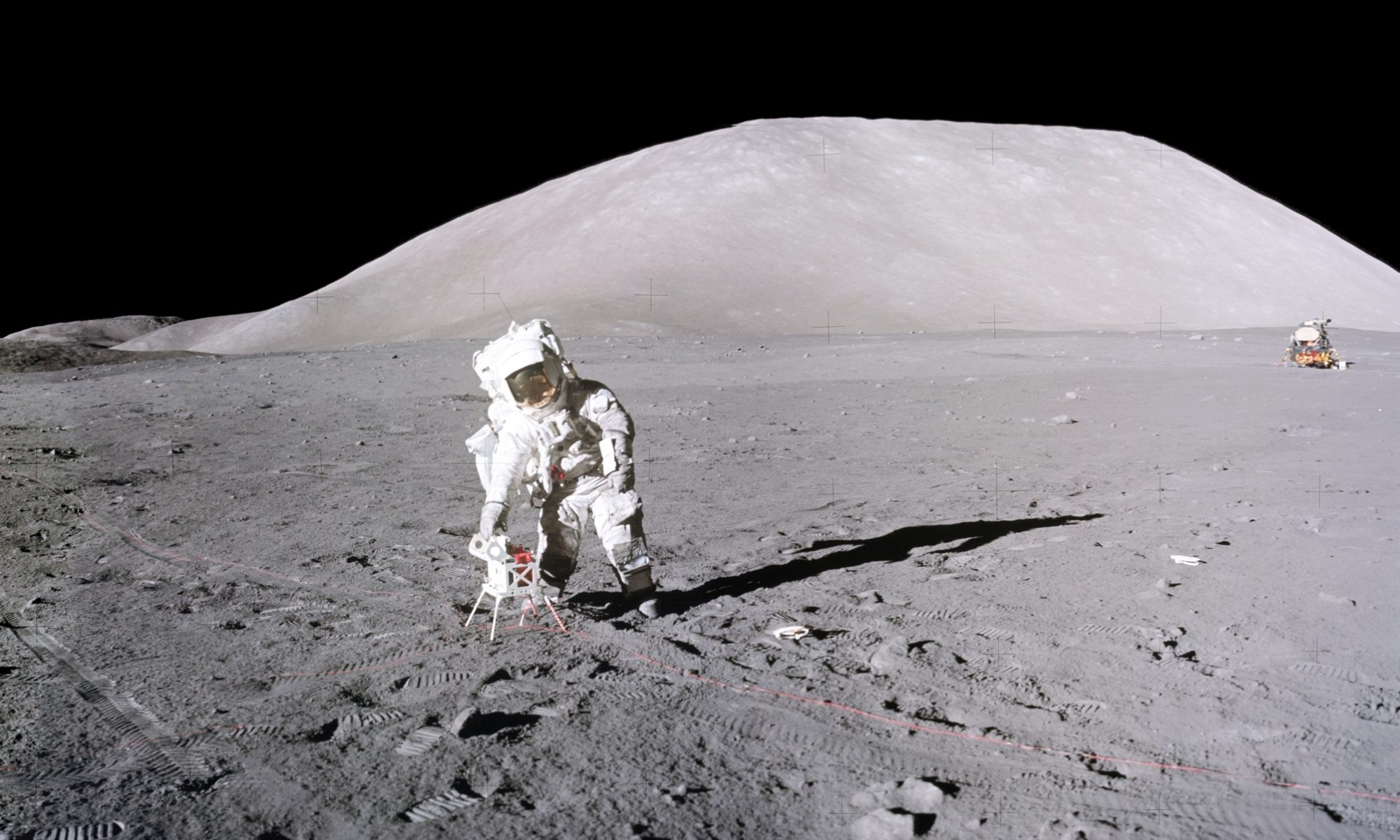
“History in the Dust,” Chapter 13, Section 1 of the “Apollo 17: Diary of the Twelfth Man,” (right sidebar) is a synthesis of the crew’s geological observations and photography chronicled in Chapters 10-12 and the author’s integrated interpretations of the extraordinary library of sample analyses published since 1972. Chapter 13 constitutes the eighth installment of the “Diary” and deals primarily with the geology of the lunar regolith present in the valley of Taurus-Littrow as well as the implications of that geology relative to the histories of the Moon, Earth and Sun. Chapter 13, Section 2, “Origin of Life,” extends lunar regolith geology to a water-rich Earth. It treats the catalytic effects of the chemistry of phyllosilicates, formed primarily on the Earth and Mars by the hydrous alteration of regolith, in the formation of the self-replicating organic molecules of RNA and possibly DNA in the origin of life on Earth.